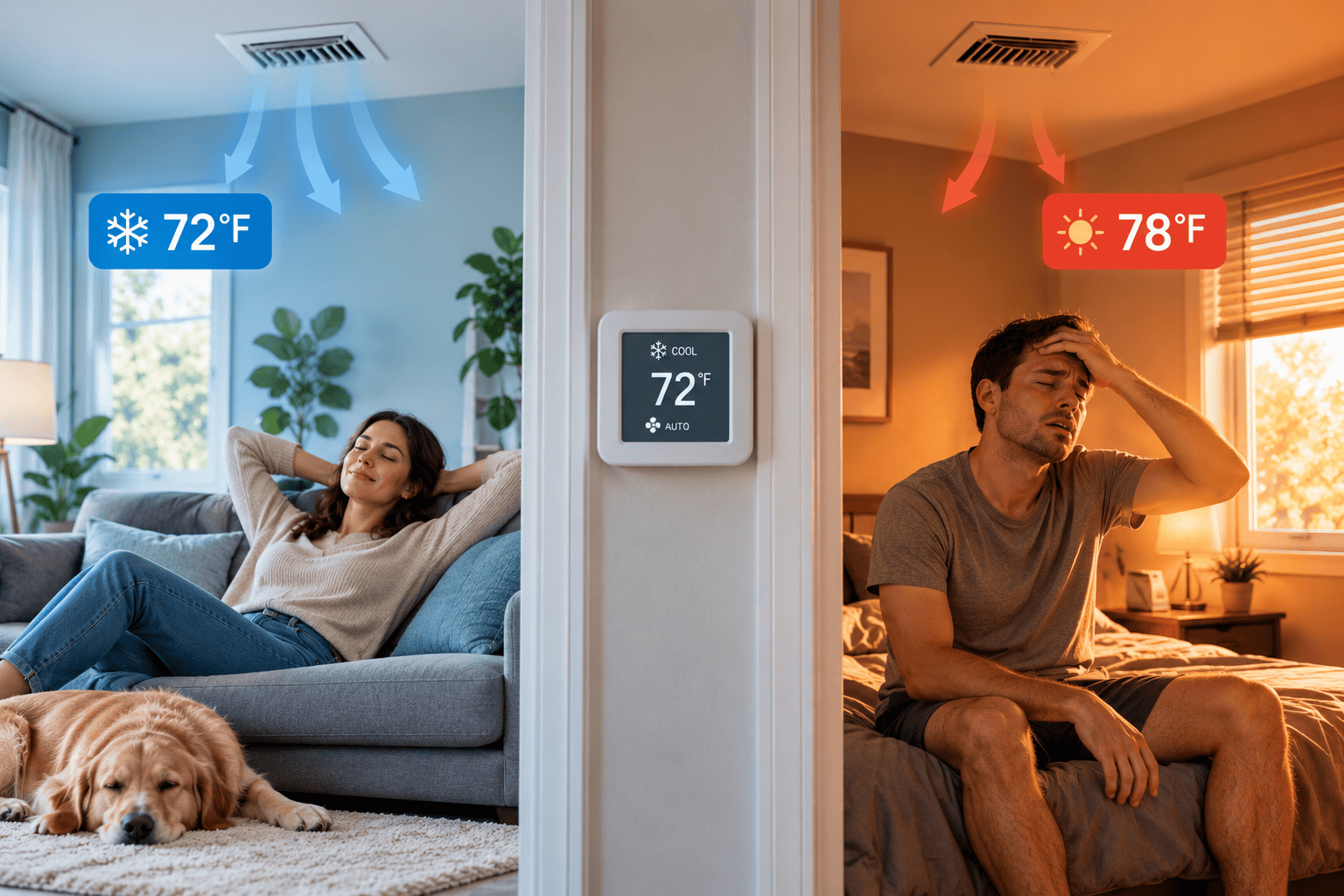

Your thermostat says 72°F. Your central air conditioner is running. The house isn’t particularly hot — but something still feels wrong.
The air feels heavy. The rooms feel sticky. You may even notice condensation around vents or a musty feeling in certain areas.
In this situation, lowering the thermostat isn’t always the answer.
A central AC system doesn’t only remove heat from your home. During normal operation, it also removes moisture from the indoor air. If your home stays humid while the AC is running, it can be a sign that the system isn’t removing moisture effectively.
Here’s why that happens and what you can check.
How Does Your AC Remove Humidity?
When warm indoor air passes over the cold evaporator coil, two things happen:
- The air temperature drops.
- Moisture in the air condenses on the coil.
That moisture is collected and drained away through the condensate system.
But removing humidity takes time.
If your AC turns on, quickly reaches the thermostat temperature, and shuts off again, the house may become cool before enough moisture has been removed.
That’s why a home can technically be at the “correct” temperature and still feel uncomfortable.
1. Your AC May Be Too Large for Your Home
It sounds logical that a larger air conditioner would cool a house better.
But bigger isn’t always better.
An oversized central AC system can lower the indoor temperature very quickly. The thermostat reaches its set temperature, the system shuts down, and the cooling cycle ends.
The problem is that the system may not have operated long enough to remove enough moisture from the air.
The result can be:
- Short cooling cycles
- High indoor humidity
- Uneven comfort
- A cool but clammy feeling inside the home
If this problem has existed since the AC was installed, system sizing may be worth investigating.
2. Your AC Is Short Cycling
Even a correctly sized system can begin turning on and off too frequently.
This is known as short cycling.
Instead of completing normal cooling cycles, the AC repeatedly starts and stops.
Possible causes can include thermostat problems, airflow restrictions, refrigerant issues, electrical components, or other system faults.
Short cycling matters for two reasons.
First, shorter operating periods reduce the amount of moisture the system can remove.
Second, frequent starts and stops can put additional stress on AC components.
If you notice your central AC switching on and off every few minutes, it shouldn’t be ignored.
3. Your Thermostat Fan Is Set to ON
Take a look at your thermostat.
Does the fan setting say:
ON
or
AUTO?
This small setting can make a difference.
When the fan is set to AUTO, the blower normally operates along with the cooling cycle and stops afterward.
When it’s set to ON, the blower can continue circulating air after the compressor has stopped.
In some systems, moisture remaining on the evaporator coil can then be introduced back into the indoor air instead of draining away.
For normal cooling operation, AUTO is often the better setting unless your system has been specifically configured differently.
4. There May Be an Airflow Problem
Your AC needs the correct amount of airflow across the indoor coil.
Too little or otherwise incorrect airflow can affect both cooling performance and humidity removal.
Possible airflow problems include:
- A clogged air filter
- Blocked return vents
- Closed supply vents
- A dirty evaporator coil
- Blower problems
- Restricted ductwork
You can start by checking the air filter and making sure accessible vents aren’t blocked by furniture or other objects.
More complicated airflow problems require proper testing.
5. Your Ductwork May Be Pulling Humid Air Into the System
The problem isn’t always the AC equipment itself.
Your ductwork may run through an attic, crawlspace, garage, or another unconditioned area.
If return ducts have significant leaks, the system may pull hot and humid air from those spaces into the HVAC system.
That additional moisture then has to be removed by your AC.
Possible signs of duct-related problems include:
- Some rooms feel more humid than others
- Uneven temperatures throughout the house
- Weak airflow in certain rooms
- Higher energy bills
- Comfort problems that become worse during very hot or humid weather
A duct inspection can help determine whether air leakage is contributing to the problem.
6. The Problem Could Be Coming From the House
Not every humidity problem is caused by the air conditioner.
Moisture can enter or develop inside a home through many sources, including:
- Air leaks around doors and windows
- Bathrooms without adequate exhaust
- Cooking
- Plumbing leaks
- Crawlspaces
- Basements
- Frequent opening of exterior doors
- Outdoor humid air entering the home
If your AC appears to operate normally but indoor humidity remains unusually high, the source of the moisture may need to be investigated separately.
7. Your AC May Have a Mechanical Problem
If your home suddenly became more humid when it wasn’t before, pay attention.
A change in humidity can sometimes appear before a complete AC failure.
For example, changes in refrigerant conditions, coil performance, airflow, or other components can reduce the system’s ability to cool and dehumidify properly.
You might also notice:
- Longer AC run times
- Weak airflow
- Uneven cooling
- Ice around refrigerant lines
- Water near the indoor unit
- Unusual sounds
- Higher electricity bills
These symptoms are useful information for an AC technician when diagnosing the system.
Should You Just Lower the Thermostat?
Not necessarily.
If the underlying problem is humidity rather than temperature, continually lowering the thermostat may make the house colder without fixing the actual cause.
Instead, determine why the AC isn’t removing enough moisture.
A properly operating central AC system should help control both temperature and indoor moisture during cooling operation.
What Can You Check Yourself?
Before calling for AC service, homeowners can safely check several basic things:
- Make sure the thermostat is set to COOL.
- Set the thermostat fan to AUTO.
- Inspect the air filter.
- Make sure supply and return vents aren’t blocked.
- Look for visible water or ice around the indoor AC equipment.
- Check for obvious moisture sources inside the home.
- Pay attention to how frequently the AC starts and stops.
Avoid opening electrical components or attempting to work with refrigerant yourself.
When Should You Call an AC Technician?
Consider having your central AC inspected if humidity remains consistently high despite normal cooling operation.
Professional diagnosis is especially important when you also notice short cycling, weak airflow, water, ice, unusual noises, or noticeably worse cooling performance.
The goal isn’t simply to make the house colder.
It’s to determine why the system isn’t controlling indoor comfort the way it should.
Frequently Asked Questions
Why is my house humid even though the AC is running?
Your AC may not be operating long enough to remove sufficient moisture. Short cycling, oversized equipment, airflow problems, duct leakage, thermostat settings, mechanical problems, or moisture entering the home can all contribute.
Can an AC cool a house but not remove humidity?
Yes. A system can lower the air temperature while still providing poor humidity control, particularly when cooling cycles are too short.
Can an oversized AC cause high humidity?
Yes. An oversized system may cool the house quickly and shut down before sufficient moisture has been removed from the indoor air.
Should the AC fan be set to AUTO or ON?
For many residential central AC systems, AUTO is preferable during cooling. It allows the blower to stop after the cooling cycle instead of continuously circulating air.
Why does my house feel hotter when the humidity is high?
High humidity can make indoor conditions feel less comfortable even when the thermostat temperature hasn’t changed significantly. That’s why temperature alone doesn’t always tell the full story about indoor comfort.
Is high humidity a sign that my AC needs repair?
Not always. The source could be the building itself, outdoor conditions, ductwork, or AC system design. However, a sudden or persistent increase in humidity — especially combined with other AC symptoms — is a good reason to have the system evaluated.
Central AC Problems? We Can Help
If your home feels humid, sticky, or uncomfortable even while your central AC is running, simply lowering the thermostat may not solve the problem.
Cooling & Heating Repair can inspect your central AC system, airflow, and cooling performance to help identify what’s causing the comfort issue.
A proper diagnosis can tell you whether the problem is related to the AC equipment, airflow, controls, ductwork, or another part of the cooling system.